
PESCO Tariff Rates 2026 – Unit Price, Slabs & Protected Status Explained
Last updated: – Reflects latest PESCO tariff and unit ratesPESCO Tariff rates and slab structures form the foundation of every PESCO electricity bill. These rates are determined and approved by NEPRA (National Electric Power Regulatory Authority), while PESCO (Peshawar Electricity Supply Company) implements them in consumer billing.
However, the final per-unit price on your bill is not limited to the base PESCO tariff alone. It may also include Fuel Price Adjustment (FPA), Quarterly Tariff Adjustment (QTA), fixed charges, and other taxes. This page explains how electricity electricity units (kilowatt-hour or kWh), tariff slabs, and protected or non-protected consumer status influence your total bill amount and why your payable amount may increase or decrease from month to month. You can check your latest bill using our PESCO Online Bill tool.
What Is One Electricity Unit (kWh)?
Electrical energy consumption is measured in units called Kilowatt-hours (kWh). The word kilo means one thousand. When a 1,000-watt electrical appliance operates for one hour, it consumes one unit (1 kWh) of electricity.
This unit (kWh) is the basic PESCO Tariff measurement used on your PESCO electricity bill to calculate total consumption for the billing period.
How PESCO Tariff Slabs Work
NEPRA approves the slab-based tariff structure, which PESCO implements in consumer billing. Under this system, monthly electricity consumption is divided into different slabs or unit ranges based on the total number of units consumed. The PESCO tariff structure follows a slab-based pricing model.
When electricity usage exceeds a defined slab boundary in a billing month, the next slab rate becomes applicable. This rate, which is higher, is applied only to the excess units within that slab range. The PESCO electricity unit rate varies depending on the slab and consumer category.
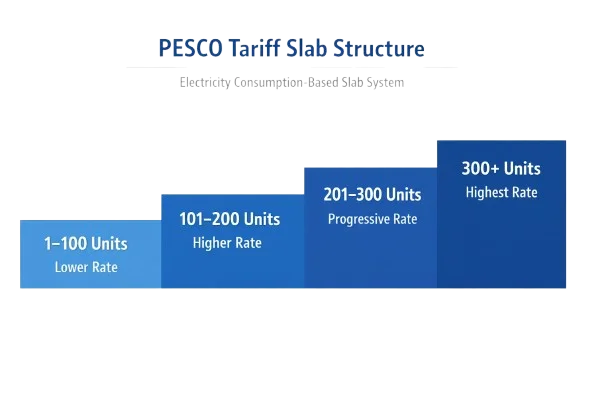
The slab-based system is designed to promote responsible electricity consumption by maintaining lower rates for modest usage while applying progressively higher rates to heavier consumption levels. The following table shows how domestic PESCO tariff slabs are typically structured:
Structure of Domestic PESCO Tariff Slabs
Unit Range (Monthly Consumption) |
Consumer Category |
Billing Type |
|
1 – 100 Units |
Domestic (Protected / Non-Protected) |
Lowest slab rate |
|
101 – 200 Units |
Domestic |
Higher slab rate |
|
201 – 300 Units |
Domestic (Non-Protected) |
Progressive rate |
|
301 – 400 Units |
Domestic (Non-Protected) |
Higher progressive rate |
|
401 – 500 Units |
Domestic (Non-Protected) |
Elevated rate |
|
500+ Units |
Domestic (Non-Protected) |
Highest residential slab |
In summary, different portions of monthly bill is charged at different rates depending on in which slab they fall. For example, if a consumer uses 250 units in one month:
- The first slab units are charged at the lowest rate.
- The next slab units are charged at a higher rate.
- Any remaining units fall into the next applicable slab and charged even higher.
This slab-based calculation is one of the main reasons why electricity bills can increase significantly when monthly consumption crosses certain thresholds. For a close estimation, see our PESCO bill calculator.
The PESCO bill per unit depends on the applicable slab and consumer classification.
Protected vs Non-Protected Consumers
Who Is a Protected Consumer?
Under the PESCO tariff policy, protected consumer is a domestic electricity user whose monthly consumption remains within the defined protected threshold set under the regulatory framework. This threshold is generally linked to consumption up to 200 units per month, subject to applicable policy rules. To estimate your monthly charges under different slabs, use our PESCO Bill Calculator.
When a consumer’s usage stays within this limit over the required evaluation period, protected slab rates apply. These rates are lower compared to standard non-protected domestic slabs and are designed to support modest household consumption.
Who Is a Non-Protected Consumer?
A non-protected consumer is a domestic user whose electricity consumption exceeds the defined protected threshold.
Once the threshold is crossed, the consumer is billed under the non-protected slab structure. Under this structure, higher slab rates apply progressively as consumption increases.
The change in classification depends on consumption patterns and applicable regulatory rules governing evaluation periods.
Other Charges That Affect Your Final Per-Unit Cost
In addition to the base tariff and slab rates, several other factors influence the final per-unit cost on your electricity bill.
Fuel Price Adjustment (FPA)
Fuel Price Adjustment shows monthly variations in fuel prices used for electricity generation. Changes in fuel prices may increase or decrease your bill because of its effect on power production cost.
Quarterly Tariff Adjustment (QTA)
Quarterly Tariff Adjustment shows cost differences identified over a three-month period. These tariff adjustments are applied in accordance with regulatory body (NEPRA) approvals.
Taxes and Fixed Charges
Your bill may also include:
- General Sales Tax (GST)
- Electricity Duty
- Fixed Charges
- Meter Rent
These components vary depending on consumption level, tariff category, and government policies.
Frequently Asked Questions
How do I know if I am a protected consumer?
Protected status is determined automatically based on your recent electricity consumption history. If your usage remains within the defined protected threshold under the domestic tariff category, protected slab rates apply. You do not need to submit a separate application.
Does exceeding 200 units once remove protected status?
Classification depends on consumption patterns and regulatory evaluation rules. Exceeding the threshold may affect your classification for a defined billing period according to applicable policy guidelines.
Why does my PESCO bill increase even if my units seem similar?
With similar number of units consumed your electricity bill may vary due to Fuel Price Adjustment, Quarterly Tariff Adjustment, changes in fixed charges and taxes. Any changes in slab classification also affects the bill.
What is the current PESCO unit price?
PESCO unit price is a variable figure and is determined by your tariff slab and your consumer category. You can check the unit price applicable to you on your latest PESCO Bill copy.
Understanding the PESCO tariff system helps you estimate your electricity cost accurately.